Dobreyshov's Four Gospels
A manuscript from the early 13th century
We are preparing for the next edition of the Festival of European Languages in Riga, at which we will present Bulgaria and the Bulgarian language for the third time in a row. We try to present new and interesting facts about the Bulgarian language and literature every year.
In this way, we fill in our library and knowledge with new books and information. This year we will present Bulgarian manuscripts that we have not presented in the past two years, such as the Codex Assemanius and the Banitsa Gospel.
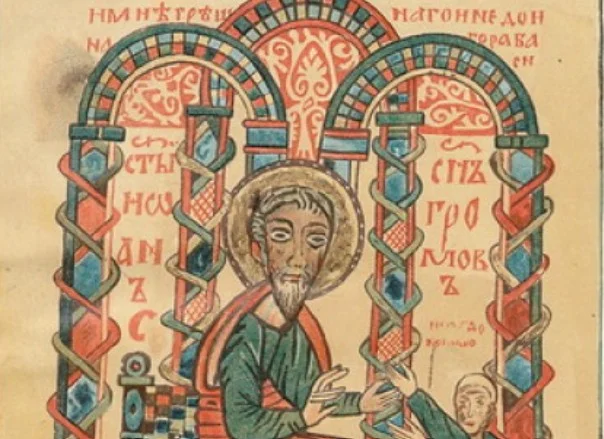
While collecting additional materials for manuscripts with interesting fates, I came across the Dobreisho’s Gospels - a Middle Bulgarian illuminated manuscript from the beginning of the 13th century.
The manuscript was discovered in the city of Tulcea (present-day Romania) in the 19th century, but was divided into 2 parts.
The largest part (127 leaves) entered the collection of the Bulgarian National Library in Sofia in 1899, where it is kept and studied to this day. The other part of 48 leaves ended up in the National Library in Belgrade before 1882 and was completely burned during the Hitlerite bombings of Belgrade on 6 April 1941, which burned the library to the ground.
Fortunately, the prominent Bulgarian linguist Prof. Benyo Tsonev thoroughly studied these 48 pages of the manuscript at the beginning of the 20th century and published a complete academic edition of the monument in 1906. Prof. Tsonev’s book is entitled “Dobreysho’s Four Gospels. A Middle Ages Bulgarian monument of 13th century” and is part of the emblematic series “Bulgarian Antiquities” of the Ministry of Public Education. The edition contains a detailed description of the manuscript, paleographic tables, a full set of photographic reproductions of the miniatures and, most importantly – an accurate literal transcription of the entire text.
In addition to its interesting courtroom, the manuscript is known as one of the most striking monuments documenting the early transition of the Bulgarian language from synthetism (a rich case system) to analytism (expression of relations through prepositions and the emergence of an article form).
Come to our stand at the National Library of Latvia on 18 September 2026 (Friday) to learn more about the significance and fate of the manuscript.